Outbreak - Day 0
GENRE: 3D Action Adventure / FPS
TYPE: Narrative level design case study
ENGINE: Far Cry 5 Editor
FOCUS: Analysis and recreation of The Last of Us’ opening sequence
DURATION: 2 weeks
ROLE: Level Designer
Recreated the emotional pacing and player-guidance principles of The Last of Us opening sequence in a playable custom level.
Designed a chaotic evacuation route using framing, lighting, blocked paths, enemy pressure, and environmental cues instead of explicit UI guidance.
Focused on translating cinematic tension into interactive spatial design while keeping the player oriented through smoke, darkness, and panic.
Level overview
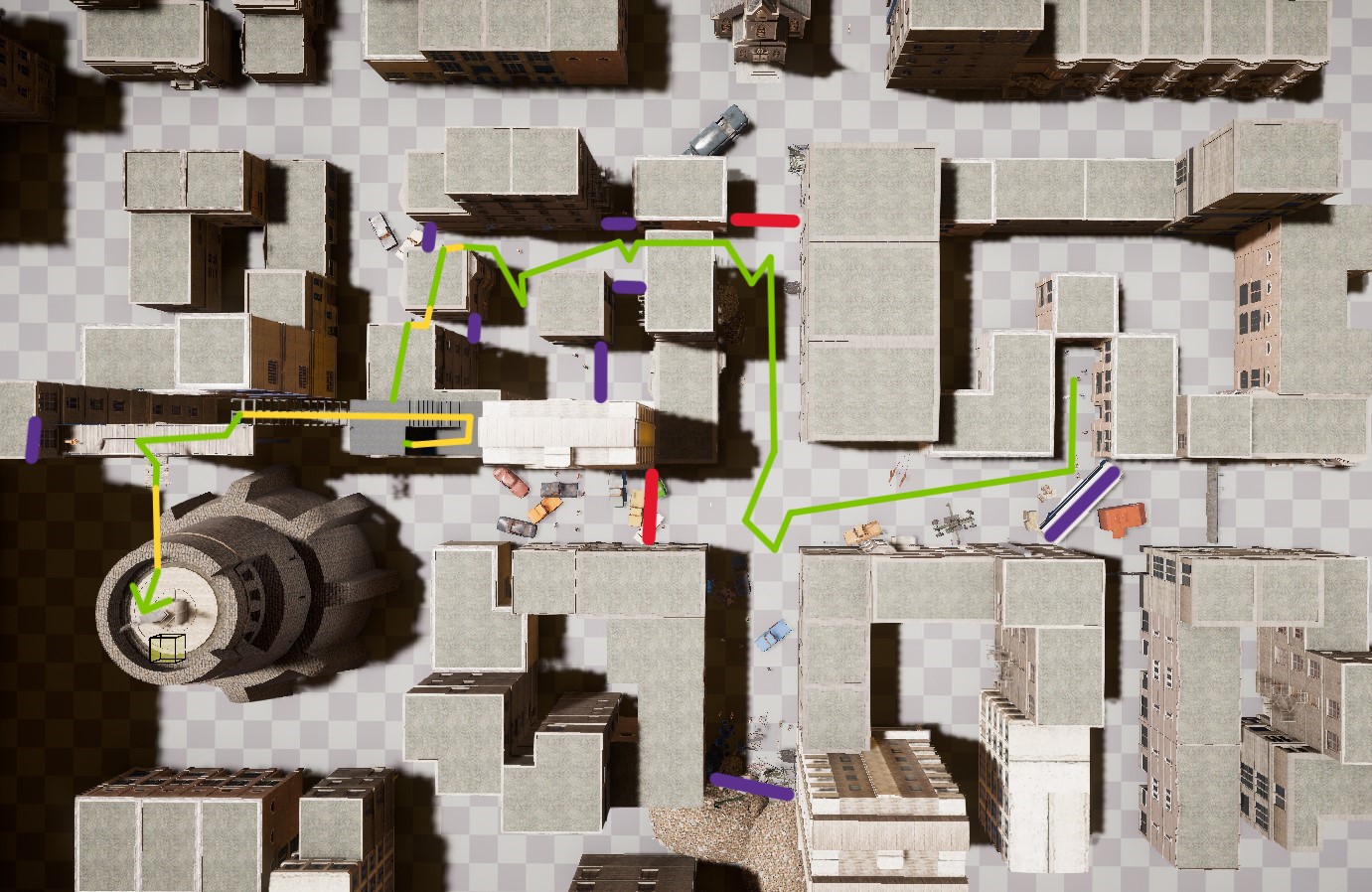
Design Goals
The goal was to study how The Last of Us opening sequence guides the player through chaos without relying heavily on explicit UI, then apply those principles to an original playable level.
The design focused on three main intentions:
Keep the main objective readable through framing, lighting, and recurring visual anchors.
Create panic and urgency without turning navigation into confusion.
Translate cinematic tension into player-driven movement, where the player still feels in control of the route.
Highlight 1: Framing
Across the level, architectural composition is used to keep the main objective and route readable without relying on UI markers.
Street alignments, building silhouettes, openings, and vertical elements frame the different landmarks from various points in the route. The goal was to make the player feel surrounded by a dense, chaotic city while still preserving a clear sense of direction.
Highlight 2: Light Guidance
Lighting is used as a soft guidance layer throughout the level, helping the player read safe paths, danger zones, and the main objective.
Bright windows, fire, flickering lights, and illuminated monuments create contrast inside the smoke and darkness. The goal was to guide attention and reinforce direction without making the route feel overly marked or artificial.
Outcome
This project helped me better understand how cinematic pacing can be adapted into interactive level design.
The final level uses framing, lighting contrast, blocked routes, enemy pressure, and environmental cues to guide the player through a chaotic city sequence without relying only on UI markers. It became a focused study in soft guidance, readability, and emotional pacing.